
BREAKPOINT ADVISORS INSIGHTS
Big Theme: Steady hands in changing lands: balancing CRE risk and reality
Look Back - 2Q 2026
And just like that, the Massachusetts rent control petition is dead, at least for 2026. The state’s Supreme Judicial Court struck down the proposal on June 23, concluding that the petition “relates to religion, religious practices or religious institutions,” which the state Constitution does not allow to go before voters. Despite this setback, proponents of the rent control initiative intend to resubmit in 2028, but until then, what one Boston-based developer cited as a “DEFCON 1” situation has cooled considerably.
By comparison, in NYC, on June 23, the Rent Guidelines Board passed a two-year rent freeze on rent-stabilized units. This decision directly impacts properties that received a 421-a tax abatement, yet there are often supplemental charges permitted by the landlord that could mitigate the sting of zero percent rent growth for the period commencing October 1, 2026.
From a valuation perspective, rent growth really matters! Obvious, yes, but particularly so in light of rising costs. As the Fed’s May Beige Book notes (published June 3), developers across districts continue to cite rising input, insurance, fuel, energy, and borrowing costs as factors delaying projects, compressing margins, and increasing uncertainty.
Against that backdrop, commercial real estate values across sectors remained relatively flat as we wrapped the second quarter. Still, the market remains far from uniform. Takeaways include:
- Data centers remain the strongest demand driver in CRE, with AI fueling development from Cleveland to Atlanta, Dallas, and San Francisco.
- Class A office continues to separate from the broader office market, led by near-record volumes in Manhattan, driven predominantly by AI-focused industries.
- Industrial activity remains resilient but uneven, with solid demand in the Sun Belt and softness in the Northeast.
- Multifamily is stabilizing, but rents continue to face pressure from elevated supply and ongoing concessions.
- Capital markets remain cautious as investors expect rates to stay higher for longer.
Bottom line: CRE is a highly bifurcated investment sector. Data centers, Class A office, medical, education, government, and select industrial assets continue to attract demand, while rate-sensitive property types face pressure from elevated costs, geopolitical influences, and a slower capital markets environment. The most notable signal may be that AI is no longer just a technology story; it is also a real estate story.
Look Ahead - 3Q 2026
As we look ahead to the third quarter, many of the themes witnessed in 2Q are anticipated to repeat themselves. Yet, one of the more curious trends we’re seeing is the push to call any bit of surplus or excess industrial land an IOS opportunity.
For the sake of showing the IOS sector full respect, we’ll call it “IOS light.” These “IOS light” opportunities appear to be rising in popularity and are often a secondary use to the original intent when sites were first developed. The real estate in question can be legitimate ancillary paved lots (think oversized truck courts not in use) or grassy acreage adjacent to leased warehouses that was once viewed as future expansion potential. Whereas in the past we would first determine whether the additional acreage is excess or surplus land and then determine value, if material, there seems to be a growing trend to call any additional acreage an IOS opportunity and assign a revenue stream to it. For those grassy knolls, caution should be exercised. If we are picking up rent either directly or indirectly through a hybrid warehouse/IOS calculation, where are the development costs? Also, does the zoning even allow IOS uses?
From our perspective, this trend reflects two truths: 1) owners are always looking for value; and 2) properties are often more complex than first meets the eye. As valuers, we look at each asset from every angle – and we hope our diligence and attention to detail are appreciated.
So “IOS light” aside, you recall how we mentioned above that one of the primary stories continues to be the data center boom? Well, it is also one of the most contentious CRE stories today that (gasp) appears to be uniting Republicans and Democrats. From Florida to Kansas, Americans across the political divide are pushing back. According to a recent Gallup poll, seven in 10 Americans oppose constructing data centers for artificial intelligence in their own communities, including nearly half (48 percent) who are strongly opposed.
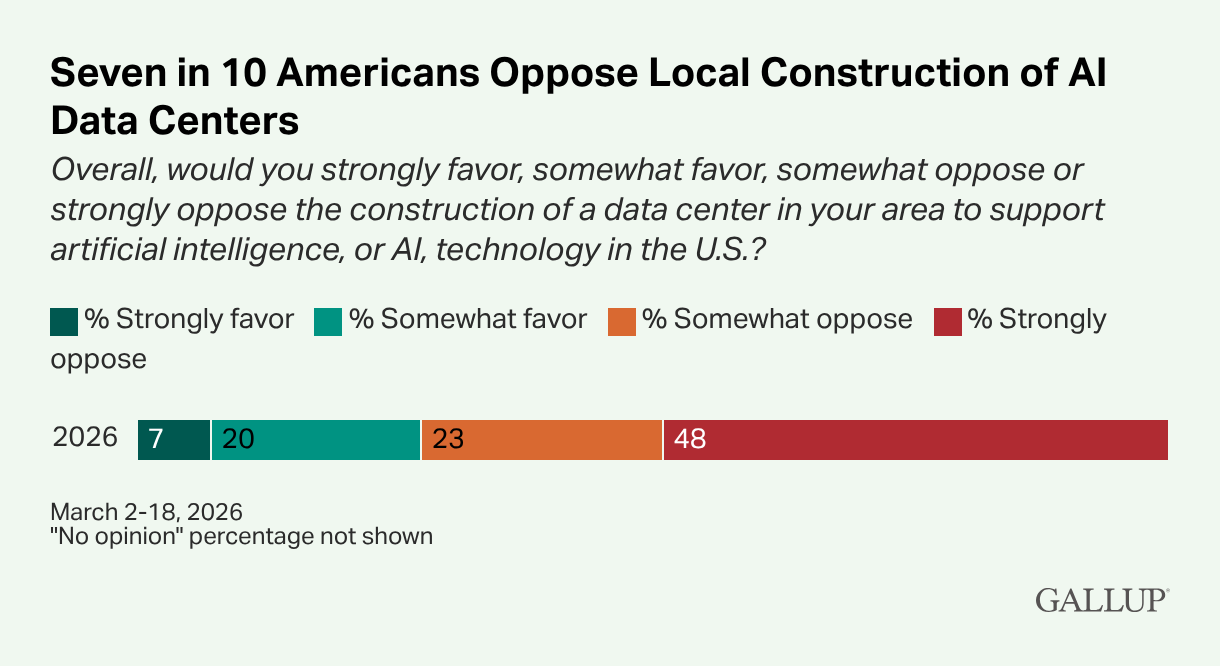
The opposition is predominantly tied to environmental and quality-of-life concerns. A recent article in Fortune notes that at least 48 data center projects representing $156 billion of investment were blocked or stalled by local opposition in 2025 alone, according to Miquel Vila, a supply chain and political risk analyst at 10a Labs who maintains the Data Center Watch initiative. Project cancellations jumped from six in 2024 to 25 in 2025, and in the first quarter of 2026, more than 20 additional projects were killed — a record quarterly pace. There are now 188 local opposition groups operating across 40 states. And when Americans unite forcefully behind a singular issue, woe to those who stand in the way. This is absolutely an issue we will be following closely.
What We’re Up To
Caitlin Bevis, MAI, MRICS, Elected to Regional Chapter Board
Breakpoint Advisors’ Managing Partner, Caitlin Bevis, was recently elected to the Board of Directors of the Massachusetts, Rhode Island & Maine Chapter of the Appraisal Institute for a three-year term beginning January 1, 2027, and continuing through December 31, 2029. In this role, she will contribute to the chapter's governance and strategic direction, supporting its mission and advancing the professional standards of the appraisal community across the region. Congratulations, Caitlin!
What are you up to this quarter? We’re here to serve your needs. We appraise all core property types as well as data centers, cold storage, self-storage, senior living, and more.
This newsletter reflects the personal opinions of the author and is provided for general informational purposes only. It is not intended as legal, financial, or professional advice.
READ MORE INSIGHTS
CRE Market Update Q2 2026
We started the year off with cautious optimism for the CRE sector, and that sentiment remains the same. There’s been ongoing debate regarding multifamily rent growth—we are inclined to believe Mamdani means what he says (more on that in our Look Ahead), while others…
CRE Market Update Q1 2026
Getting right to it, here’s what we personally witnessed in the fourth quarter:
• Office values remain under pressure for the most part, with some exceptions for best of the best assets.
• Life science values continue to slip due to a supply-demand imbalance and l…
CRE Market Update Q4 2025
Real estate investors appear to be coming off the sidelines as there is growing consensus that we are at – or near – bottom. As noted by Green Street in their August U.S. Commercial Property Outlook, real estate fundamentals are decent, but vary by sector. Senior …